


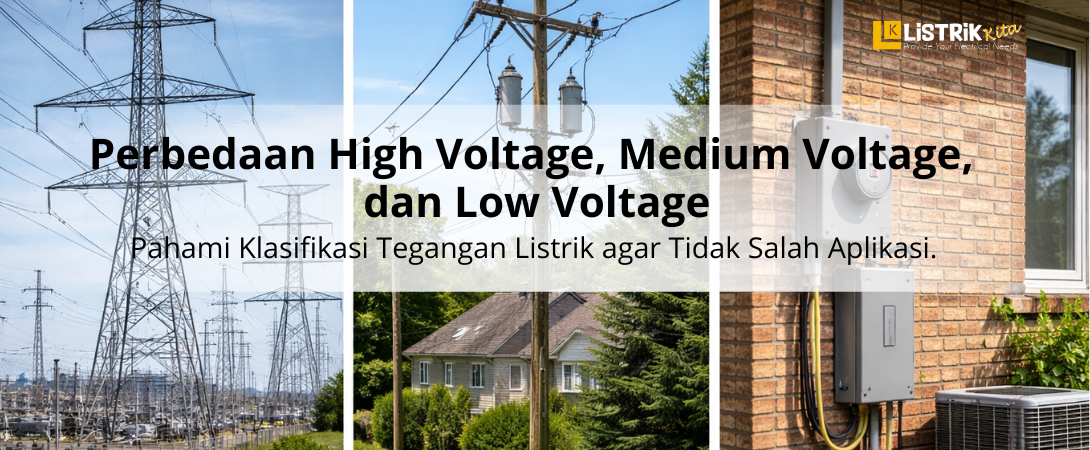
Have you ever noticed the regular power poles in front of your house, but also seen giant towers along the highway? This difference is closely related to how we classify electrical voltage. In the world of electricity, voltage is divided into three main categories: High Voltage (HV) , Medium Voltage (MV) , and Low Voltage (LV).
Understanding the differences between these three is important so we know how electricity reaches our homes and why safety procedures around electrical installations are so crucial.
Why Does Electricity Need to Be Classified?
Electricity must be sent from power plants that might be hundreds of kilometers away to our homes. Without voltage classification, this process would not be efficient and would be very dangerous. The classification into HV, MV, and LV allows electricity to be transmitted over long distances, distributed throughout cities, and used safely in our electronic devices.
Definition and Voltage Ranges
Although there are slight differences in standards between countries, generally the voltage ranges are as follows.
Low Voltage (LV)
LV is the voltage we use directly every day, up to 1000 Volts or 1 kV. In Indonesia, homes use 220 Volts, while light industries use 380 Volts.
Medium Voltage (MV)
MV acts as a bridge between long-distance transmission and end use, with a range of 1 kV to 36 kV. The PLN network on power poles usually carries 20 kV voltage before it is stepped down by transformers.
High Voltage (HV)
HV is used for long-distance transmission, ranging from 36 kV to 230 kV. The SUTET network with its tall towering structures carries 150 kV or 500 kV voltage across provinces.
Differences in Application and Use
Each voltage level has a different role in the electrical ecosystem.
Low Voltage is used for all electronic devices in homes and offices, from LED lights, refrigerators, to air conditioners. All equipment that uses a power outlet is an LV user.
Medium Voltage is the backbone of urban distribution. From the substation, high voltage is stepped down to MV, then this cable network "travels" around the city to smaller distribution substations.
High Voltage functions for long-distance transmission. The higher the voltage, the lower the electric current, so the heat lost due to cable resistance is minimized. This is why electricity can travel hundreds of kilometers.
Differences in Infrastructure and Components
Electrical components at each voltage level are very different in terms of size and complexity.
In LV systems, the components are simple such as NYA cables, MCBs, power outlets, and switches. The insulation is not too thick because it doesn't need to withstand extreme voltage surges.
MV systems require sturdier equipment such as medium voltage panels or switchgear, vacuum circuit breakers, and distribution transformers that we often see at electrical substations.
Entering the world of HV, we are talking about house-sized power transformers, long chain insulators on SUTET towers, and giant complex circuit breakers.
Differences in Safety and Danger Levels
Safety is the most fundamental differentiating factor. The higher the voltage, the more deadly the risk.
LV can be fatal if the body is wet or if the current is large enough, but with proper insulation the risk can be relatively managed.
At MV and HV levels, the rules completely change. You don't need to touch the conductor to get electrocuted. The biggest dangers here are step voltage and flashover distance, where electricity can jump several meters toward you. Because of this, there is a Minimum Safe Distance that is strictly enforced and must not be violated by the general public.
Understanding the differences between HV, MV, and LV opens our eyes to how sophisticated modern electrical systems are. Starting from long-distance transmission at the HV level, even distribution at the MV level, to safe consumption at the LV level, everything works in harmony. This knowledge also reminds us to always respect the safety boundaries of electrical installations.
For those of you who need quality electrical equipment, from low voltage needs for home projects to medium voltage components for industrial purposes, make sure to choose reliable and original products. Visit Listrik Kita for various choices of quality electrical products that are safe, guaranteed, and meet the latest technical standards.
