


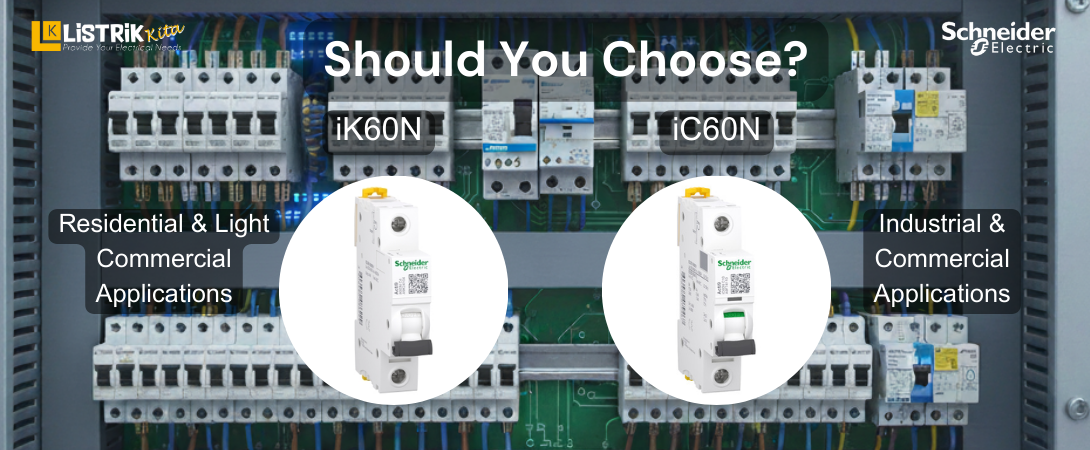
In modern electrical systems, choosing the right Miniature Circuit Breaker (MCB) is not only about basic protection. Every type of MCB is designed with different characteristics, durability levels, and breaking capacities to match the needs of specific installations. Two Schneider Electric MCB series that are often compared are the iC60N and the iK60N. Although both use curve C and are designed to provide overcurrent protection, their functions and specifications are not exactly the same.
This article explains the differences between the iC60N and iK60N, including their intended use, suitable applications, and their electrical and mechanical endurance based on official information and the data shown in the images.
MCB iK60N: Efficient Protection for General Applications
The iK60N series is designed as an economical MCB that still complies with international safety standards. It is an ideal choice for basic protection in commercial buildings and light industrial environments.
1. Key Specifications of iK60N
Based on the image, the iK60N offers several important features:
-
Curve C with a magnetic trip range between 5 and 10 In
This range is suitable for installations that often experience short bursts of high current, such as small motors, pumps, or other light inductive loads. -
Breaking capacity of 6 kA
A 6 kA rating is generally sufficient for protection in homes, shop houses, and most commercial panels. -
Electrical endurance of up to 10,000 electrical trips
-
Mechanical endurance of up to 20,000 on-off operations
-
Module width of 18 mm per pole, which is a standard size compatible with most distribution panels.
2. Suitable Applications for iK60N
The iK60N is recommended for:
-
Small to medium commercial buildings
-
Light production rooms
-
Sub-distribution panels in buildings or factories
-
Installations that do not require a high breaking capacity
With a 6 kA breaking capacity, the iK60N provides reliable protection in areas with moderate short circuit potential. It is also a cost-effective solution without compromising essential safety functions.
3. Cable Connection Capacity
The image also shows that the iK60N can accommodate:
-
1 to 25 A circuits with up to 16 mm² stranded cable or 25 mm² solid cable
-
32 to 40 A circuits with up to 25 mm² stranded cable or 35 mm² solid cable
This means the MCB supports a variety of cable sizes commonly used in commercial and industrial installations.
MCB iC60N: Premium Protection with Higher Performance
While the iK60N is aimed at general applications, the iC60N is part of Schneider Electric's premium range. It is built with stronger performance, better safety features, and higher endurance. The iC60N belongs to the Acti 9 series, which is known for its safety indicators such as VisiTrip and VisiSafe.
1. Key Specifications of iC60N
Based on the provided image, the iC60N includes several advantages:
-
Curve C similar to the iK60N, but with more accurate tripping performance
-
Higher breaking capacity
-
6 kA under IEC 60898-1
-
Up to 10 kA under IEC 60947-2
The second standard is used for industrial installations that need stronger protection against short circuits.
-
-
Electrical endurance of up to 10,000 electrical trips
-
Mechanical endurance of up to 20,000 operations
This shows that both MCBs have similar durability ratings, although the iC60N is approved for a wider range of applications due to its industrial certification.
2. Advantages for DC Installations
One of the biggest advantages of the iC60N, which the iK60N does not offer, is its ability to operate in DC systems. Supported ratings include:
-
Up to 72 VDC for 1 pole
-
Up to 125 VDC for 2 poles
-
Up to 180 VDC for 3 poles
-
Up to 250 VDC for 4 poles
This makes the iC60N suitable for solar panels, battery systems, industrial UPS units, and automatic control systems.
3. Cable Connection Capacity
The iC60N supports the same cable sizes as the iK60N:
-
1 to 25 A circuits with up to 16 mm² stranded cable or 25 mm² solid cable
-
32 to 63 A circuits with up to 25 mm² stranded cable or 35 mm² solid cable
However, the iC60N has a wider current range up to 63 A, which provides more flexibility for installations that require higher loads.
Endurance Comparison: Which One Is More Robust?
In terms of electrical and mechanical endurance, both MCB series share the same ratings:
-
10,000 electrical trips
-
20,000 mechanical cycles
Even so, the iC60N generally performs better in harsher environments, especially in industrial or DC applications where electrical behavior is more demanding. The additional features like VisiTrip and VisiSafe also help technicians identify faults faster and perform maintenance more safely.
Conclusion: Should You Choose iK60N or iC60N?
The right MCB depends on the protection level required by your installation.
Choose the iK60N if:
-
You need an economical MCB for commercial or light industrial buildings
-
A breaking capacity of 6 kA is sufficient
-
You do not require industrial certification or DC protection
Choose the iC60N if:
-
Your installation is in an industrial environment with higher short circuit risk
-
You need an MCB that works in DC systems
-
More precise and advanced protection is required
-
You want extra safety features such as VisiTrip and VisiSafe
By understanding the characteristics of each MCB, you can make a decision that is not only technically correct but also safe and efficient for long term use.
Find Schneider Electric MCBs that suit your needs only at Listrik Kita. You can also explore the differences between Schneider Electric Domae, Acti9, and Easy9 here.
