


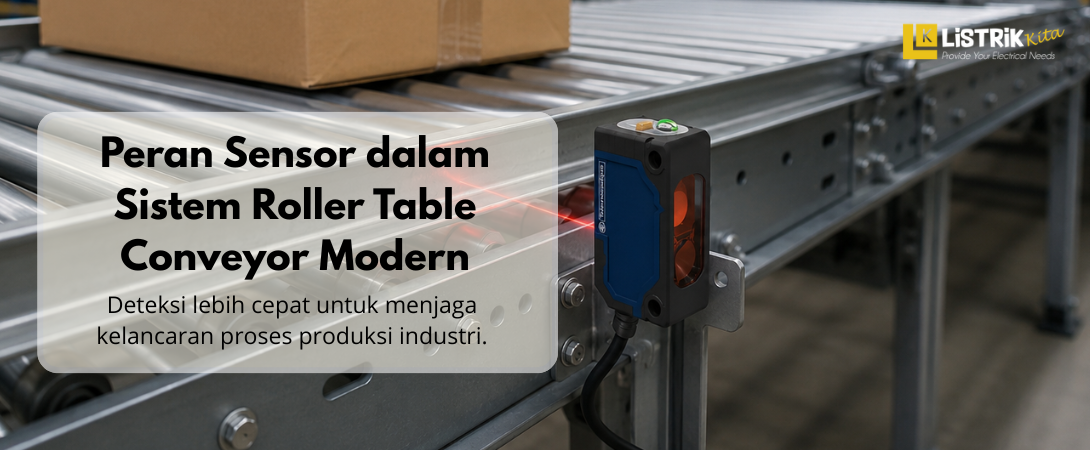
In modern industrial systems, roller table conveyors are widely used to move materials efficiently from one process to another. To ensure the conveyor operates accurately, safely, and automatically, sensors play a critical role.
Sensors act as the conveyor's monitoring system. They identify products, monitor conveyor speed, measure weight, and contribute to protecting both equipment and operators. With the right sensors, conveyor performance becomes more reliable and efficient.
Why Are Sensors Important in Roller Table Conveyors?
Sensors allow conveyors to run automatically without constant manual supervision. They send real-time data to control systems such as PLCs, enabling immediate responses when conditions change.
This improves productivity, reduces human error, and enhances operational safety.
Sensors for Object Detection
One of the main functions of sensors is detecting the presence of products on the conveyor.
Photoelectric and proximity sensors are widely used for the following purposes:
- Detect incoming products
- Identify product position
- Count items
- Prevent product accumulation
Accurate detection helps keep the production flow smooth and organized.
Sensors for Monitoring Speed and Direction
Rotary encoders are used to monitor roller speed and movement direction.
These sensors help to:
- Maintain synchronization with other machines
- Ensure the conveyor runs at the correct speed
- Detect slippage or mechanical issues
- Support consistent production quality
If abnormal speed is detected, the system can trigger an alarm or stop the conveyor.
Sensors for Load and Weight Detection
Load cells are used when the conveyor needs to measure the weight of products.
Their functions include:
- Measuring product weight
- Detecting overload conditions
- Protecting motors from excessive load
- Maintaining stable operation
This helps extend the life of conveyor components.
Sensors for Safety and Protection
Safety sensors protect both operators and equipment by detecting jams, obstructions, or unusual operating conditions.
When a problem occurs, the sensor can:
- Activate an alarm
- Stop the conveyor automatically
- Prevent further damage
- Improve workplace safety
This function is essential in industrial environments with strict safety standards.
Sensors for Integration with Other Systems
Sensors make it possible to connect the conveyor to PLC, HMI, and SCADA systems.
The collected data can be used for:
- Real-time monitoring
- Performance analysis
- Automated process control
- Predictive maintenance
This integration improves efficiency and reduces unplanned downtime.
Common Sensors Used in Roller Table Conveyors
Common sensor types include:
- Photoelectric sensors
- Proximity sensors
- Rotary encoders
- Load cells
- Safety sensors
Each sensor type is selected based on the specific application requirements.
Sensors are essential components in roller table conveyor systems. They help detect products, monitor speed, measure load, enhance safety, and integrate the conveyor with automated control systems.
For reliable industrial performance, choose genuine Telemecanique sensors. You can find original products with official warranty at Listrik Kita.
