


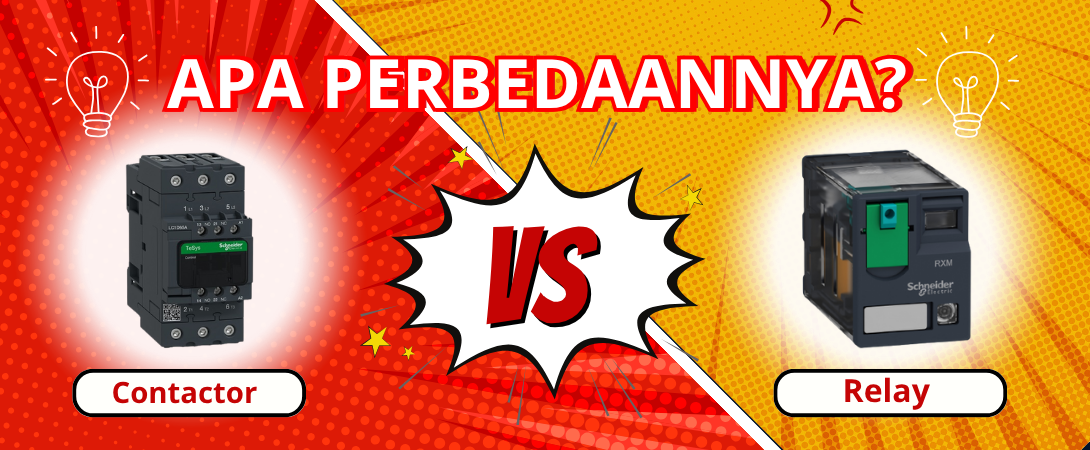
If you’ve ever dipped your toes into the world of electrical systems, automation, or even just poked around inside an electrical panel, chances are you’ve come across these two components: contactors and relays. At first glance, they look pretty similar—they both have coils, and they both connect or disconnect electric currents. But despite the visual similarity, these two devices play very different roles.
In this article, Listrik Kita will walk you through what sets contactors and relays apart—from definitions and functions to real-world applications.
What Are Relays and Contactors?
Relay: The Small but Smart Assistant
Think of a relay as the agile assistant of the electrical world. Its main job is to control low-current circuits—typically under 10 amps. Because of its compact size, you’ll often find relays in electronic devices like computers, washing machines, air conditioners, and even in automotive systems.
A relay works by opening or closing a circuit in response to a signal. That’s why they’re perfect for control systems where speed and accuracy matter. Most relays come with two types of contacts: NO (Normally Open) and NC (Normally Closed).
Contactor: The Industrial Powerhouse
On the other hand, a contactor is designed to handle high electrical loads—anywhere from 10 amps up to hundreds. You’ll usually find them in industrial environments, controlling heavy-duty equipment like 3-phase electric motors, building lighting systems, or large compressors.
Unlike relays, contactors often come equipped with extra safety features, such as arc suppression (to reduce sparking when switching) and spring-loaded contacts that keep the device stable during prolonged operation.
Key Differences Between Contactors and Relays
1. Primary Function
-
Relays are ideal for small control systems—think logic circuits or household electronics.
-
Contactors are designed to handle and control high-power electrical loads such as industrial motors, heating units, and HVAC equipment.
2. Size and Current Capacity
-
Relays are smaller in size and generally handle currents up to around 10 amps.
-
Contactors are larger and capable of switching more than 10 amps, often up to several hundred amps.
So, if you're working with heavy machinery or industrial motors, a contactor is the safer and more reliable choice.
3. System Voltage
-
Relays usually operate at lower voltages—up to about 250V.
-
Contactors are designed to manage significantly higher voltages, often up to 1000V or more, depending on the specific model.
This makes contactors the go-to component in industrial settings where high voltage and current are involved.
4. Contacts and Safety Features
-
Relays typically come with standard NO and NC contacts and don't have extra protection mechanisms.
-
Contactors often include features like spring-loaded contacts, arc suppression, and can even be fitted with overload relays for additional protection.
Where Are They Used?
Relay Applications
Relays are incredibly versatile and commonly used in:
-
Automotive systems (e.g., headlights, horn)
-
Home devices for example washing machine, air conditioners, and refrigerators
-
Microcontroller circuits
-
Low-voltage control systems
Thanks to their small size and low cost, relays are popular for DIY automation and smart home setups.
Contactor Applications
Contactors are more common in industrial and commercial environments, such as:
-
Operating large electric motors
-
Controlling building lighting systems
-
Powering factory machines and high-load equipment
-
Main electrical panels distributing large power loads
What Do They Have in Common?
Despite their differences in function and size, both relays and contactors work using the same principle: electromagnetism. When current flows through their coil, it generates a magnetic field that pulls or pushes the contact, opening or closing the circuit.
Both devices use a coil as the driving force—what sets them apart is the scale of power, durability, and safety features involved.
So, Which One Should You Use?
To help clarify things further, here’s a brief comparison:
|
Situation |
Recommended Device |
|
Controlling low-power signals, microcontrollers, or home electronics |
Relay |
|
Operating industrial motors, heavy loads, or large machines |
Contactor |
Choosing the wrong one could cause your system to malfunction—or even worse, pose a safety risk. So always match the device to your application.
Looking to buy a relay or contactor? You can find high-quality options right here at Listrik Kita!
