


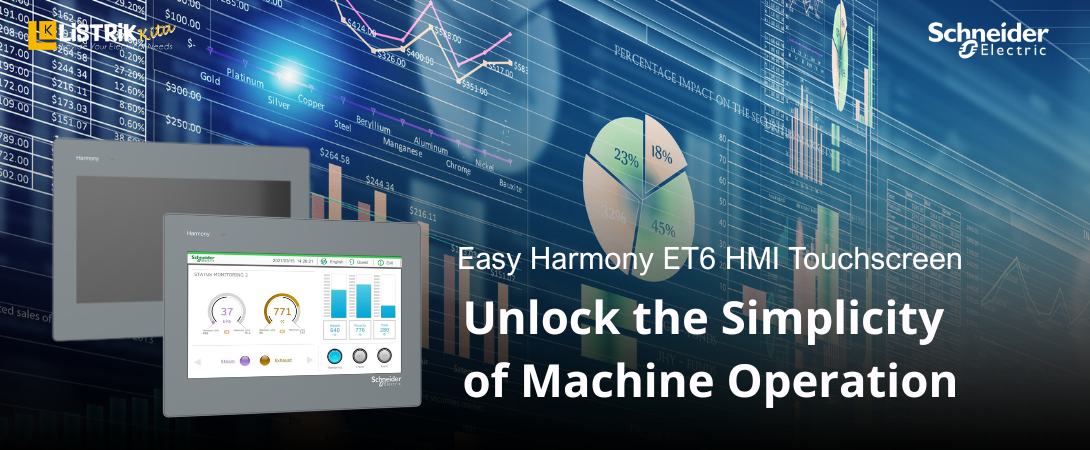
In today’s increasingly digital industrial environment, interaction between humans and machines plays a critical role in maintaining efficiency, safety, and continuity of production processes. One of the key technologies that enables this interaction is the Human Machine Interface (HMI). HMI is not just a touchscreen display. It is an intelligent system that allows humans to understand, monitor, and control machines and industrial processes in real time.
What Is HMI (Human Machine Interface)?
HMI is a combination of hardware and software designed to facilitate communication between human operators and machines, systems, or industrial processes. Through HMI, complex technical data is transformed into clear and intuitive visual displays, such as graphs, process diagrams, status indicators, and alarm notifications.
Simply put, HMI acts as a control dashboard that provides a complete overview of operational conditions. With an easy to read interface, operators can make fast and accurate decisions, even in critical situations.
Core Components of an HMI System
Modern HMI systems generally consist of three main components that work together seamlessly.
1. Input Devices
Input devices allow users to send commands or responses to the system. These include touchscreen panels, mouse devices, keyboards, and physical buttons. Touchscreen technology has become the preferred option due to its speed, simplicity, and ease of use in industrial environments.
2. Processing Unit
This component functions as the central processing unit of the HMI system. It processes and analyzes data received from machines or PLCs (Programmable Logic Controllers) and converts it into meaningful visual information.
3. Output Devices
Output devices typically include monitors, display panels, or indicator lights that show system status, process data, trend graphs, and alarms. These outputs serve as the main reference for operators when monitoring operations.
The integration of these three components enables real time monitoring and control, which is essential for maintaining stable and efficient production.
The Evolution of HMI: From Manual Panels to Smart Technology
The development of HMI did not happen overnight. In the early stages, industrial control systems relied on manual panels filled with switches, buttons, and indicator lights. While effective at the time, these systems were limited in flexibility and data visualization.
As technology advanced, HMI evolved into graphical touchscreen interfaces capable of displaying complex information within a single panel. Today, HMI systems are also integrated with Internet of Things (IoT) technology and cloud computing, allowing deeper data analysis, remote access, and seamless system integration.
This transformation has positioned HMI as more than just a monitoring tool. It is now an essential part of a smarter and more connected industrial digital ecosystem.
Who Uses HMI?
HMI is used by a wide range of professionals across different industrial roles, not just machine operators.
Operators and Production Floor Technicians
These users interact with HMI on a daily basis. Operators rely on HMI to monitor machine conditions, start or stop processes, and respond quickly to alarms when issues occur. Real time data displayed on HMI helps reduce downtime and improve productivity.
Engineers and System Integrators
Engineers and system integrators are responsible for designing, programming, and configuring HMI systems to meet specific process requirements. They ensure the interface is user friendly, efficient, and safe. A well designed HMI can significantly improve productivity while minimizing operational errors.
Managers and Operational Supervisors
When connected to SCADA or Manufacturing Execution Systems (MES), HMI allows managers to access analytical dashboards that display operational performance. Key metrics such as KPIs, production trends, and overall efficiency can be monitored from the office or remotely.
Common Applications of HMI in Real World Operations
HMI is used across nearly all industries where humans need to interact with automated systems.
Industrial Process Monitoring and Control
One of the most common uses of HMI is monitoring and controlling industrial processes. In manufacturing, food and beverage, pharmaceutical, and utility sectors, HMI is used to track temperature, pressure, flow rates, and level measurements continuously.
Data Visualization and Alarm Management
HMI converts raw numerical data from PLCs into trend graphs, mimic diagrams, and other visual formats. Integrated alarm systems provide visual or audible alerts when parameters exceed safe limits, allowing corrective actions to be taken immediately.
Efficiency Optimization and Reporting
Modern HMI systems do more than display data. They help analyze system performance. Automated reporting features can generate Overall Equipment Effectiveness (OEE) reports, energy consumption data, and production output summaries that support continuous efficiency improvement.
Integration with Other Automation Systems
HMI often serves as a centralized access point for more complex systems, including industrial robots, conveyor networks, and automated packaging machines. All of these systems can be controlled from a single HMI panel.
The Role of HMI in the IIoT and Industry 4.0 Era
As Industrial Internet of Things (IIoT) and Industry 4.0 continue to evolve, the role of HMI becomes increasingly important. HMI is no longer just a data display tool. It acts as a bridge between humans and digital industrial systems.
With advanced analytics, cloud connectivity, and remote access capabilities, HMI supports faster, more accurate, and data driven decision making. This is what makes HMI one of the key foundations of modern industrial transformation.
Visit Listrik Kita to explore a wide range of Schneider Electric HMI solutions.
