


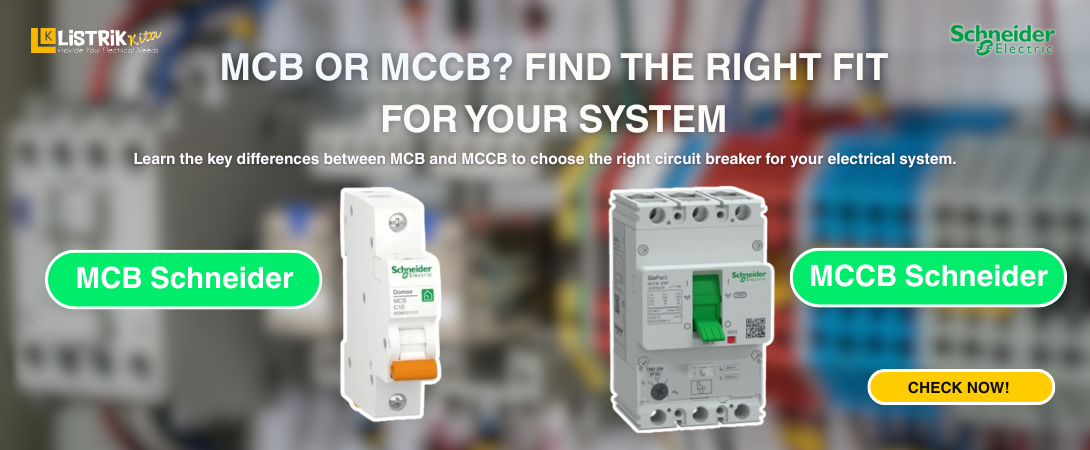
Understanding MCB and MCCB
In electrical installations, safeguarding against overcurrent and short circuits is essential. One of the main methods to provide such protection is by using circuit breakers. Two commonly used types of circuit breakers are the MCB (Miniature Circuit Breaker) and MCCB (Moulded Case Circuit Breaker). While both share the same fundamental function, they differ significantly in terms of capacity, features, and applications.
What is an MCB (Miniature Circuit Breaker)?
An MCB is a protective electrical device that automatically disconnects the power supply in the event of an overload or short circuit. Its primary purpose is to shield electrical devices from damage and decrease the risk of fire. MCBs are commonly used in residential electrical installations and applications with light to moderate loads. Because of their compact size and easy installation, MCBs are commonly chosen for residential and small commercial applications.
What is an MCCB (Moulded Case Circuit Breaker)?
Unlike MCBs, MCCBs are designed to handle larger electrical loads and higher current capacities. They come equipped with more advanced protection features, such as adjustable trip settings. Therefore, MCCBs are more suitable for industrial environments or large-scale commercial electrical installations. In addition, MCCBs often include extra features like undervoltage protection and remote operation capabilities, which are very useful in large-scale electrical distribution systems.
Key Differences Between MCB and MCCB
Although both serve as circuit breakers, MCBs and MCCBs have fundamental differences that should be understood before selecting the right type.
Technical Specification Comparison
-
MCBs are intended for lower current levels, usually up to 100 Amperes, and possess a lower breaking capacity of approximately 6 to 10 kA. Their smaller and lighter form factor makes them ideal for limited space.
-
MCCBs, on the other hand, can handle currents up to 2500 Amperes and have a much higher breaking capacity (up to 100 kA), making them the preferred choice for high-current systems.
Features and Protection Capabilities
-
MCBs typically offer basic protection against overloads and short circuits using fixed settings.
-
MCCBs provide more comprehensive and customizable protection features, such as adjustable trip settings, undervoltage protection, and remote control support. These capabilities offer better management of complex and high-density electrical systems.
Applications and Usage
-
MCBs are better suited for residential houses, small retail stores, or buildings with light to moderate electrical demands.
-
MCCBs are designed for high-capacity applications such as factories, data centers, or large commercial installations. Therefore, when choosing between an MCB and an MCCB, it’s important to consider the scale and complexity of the electrical system.
Advantages of MCB and MCCB
Each type of circuit breaker has its own advantages, depending on the specific needs of the application.
MCB Advantages
-
Compact and easy to install
MCBs feature a compact design that helps conserve space inside electrical panels. -
Quick response to overcurrent and short circuit
The automatic disconnection system reacts instantly when a fault is detected. -
Relatively affordable for household applications
Ideal for users needing basic protection without high costs.
MCCB Advantages
-
High current capacity and customizable protection settings
Flexible and well-suited for large-scale electrical networks. -
Comprehensive protection features for various load conditions
Provides more reliable and thorough protection. -
Ideal for industrial and heavy commercial applications
Specifically built to handle large loads and continuous operation.
Tips for Choosing the Right Circuit Breaker
To ensure the safety and efficiency of an electrical system, circuit breaker selection should be done carefully. Below are some factors to consider:
Important Factors to Consider
-
Current needs and load capacity
Calculate the total load to select a circuit breaker with the correct capacity. -
Type of application (residential, commercial, industrial)
Utilize MCBs for small to medium-sized applications, while MCCBs are best suited for high-load and more complex systems. -
Required protection features based on installation risk
Consider possible faults and the necessary features, such as undervoltage protection or remote control.
MCBs and MCCBs serve as crucial components in electrical protection systems. Although they share the primary function of protecting against overcurrent and short circuits, MCBs are better suited for smaller installations like households, whereas MCCBs are designed for large-scale industrial and commercial setups that demand increased capacity and enhanced flexibility. When choosing a type of circuit breaker, it is essential to align the selection with the technical requirements and usage environment to ensure a safe, efficient, and reliable electrical system.
You can find a wide variety of MCB and MCCB options only at Listrik Kita!
